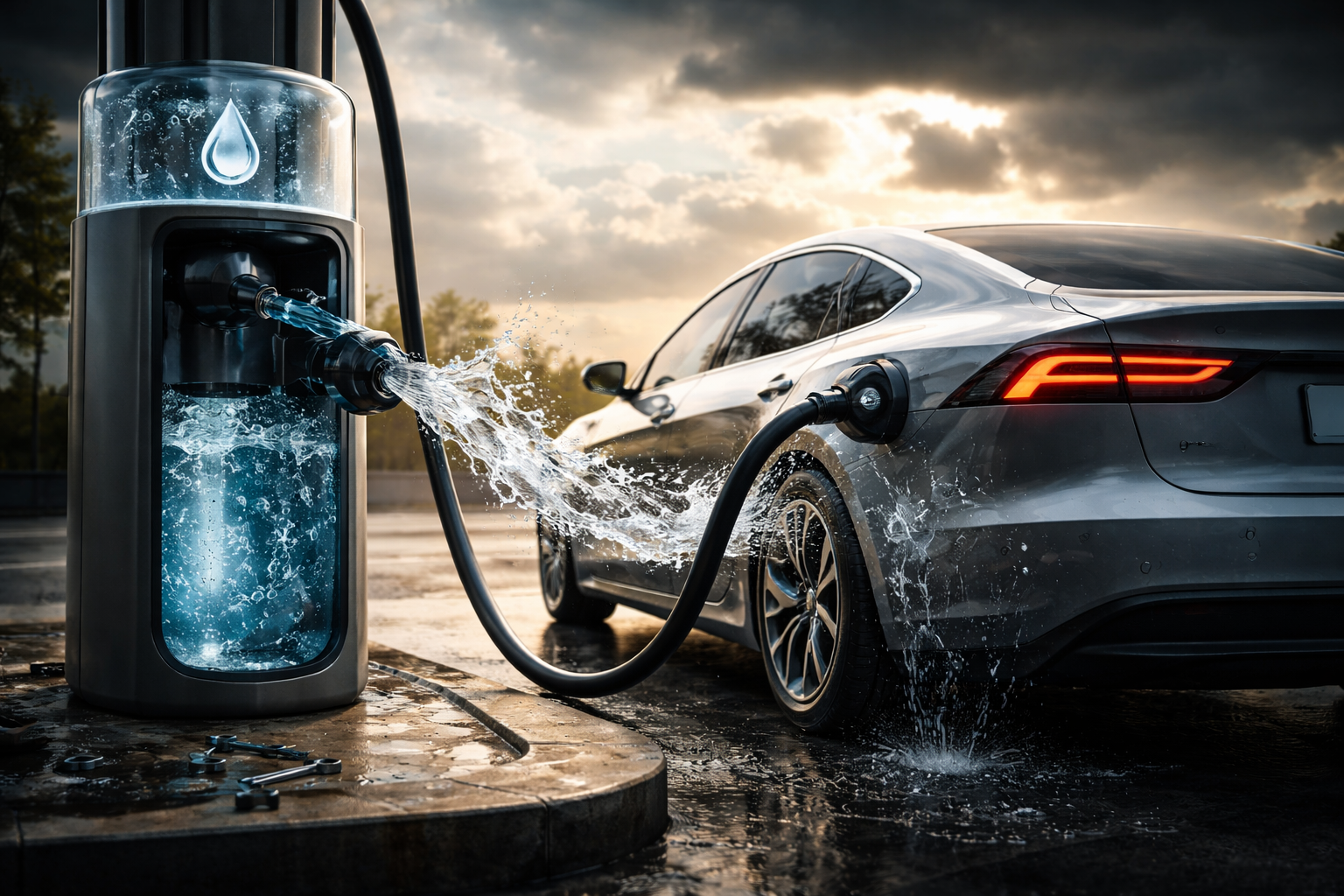
In short: no car can run on water. Water is hydrogen that has already burned, so splitting it apart always takes more energy than the hydrogen gives back. “HHO” kits can’t change that. Real hydrogen cars fill up with hydrogen made elsewhere, and in 2026 the cheapest way to cut driving costs is an EV charged at home.
Every few years the same story goes viral: a carmaker, a garage inventor or a small startup has built an engine that runs on tap water. In mid-2025 it was Toyota’s turn, with posts claiming the company had unveiled a “water engine.” Toyota told AAP FactCheck its hydrogen cars “emit water, but are not powered by water.” Here’s why physics rules it out, and what really lowers driving costs.
Why a car can’t run on water: the energy balance
Think of water as ash. When hydrogen burns, or reacts with oxygen in a fuel cell, it releases energy and becomes water (H2O). The energy is gone; what’s left is the “burnt” product. To use that hydrogen again you have to pull the water apart, and that takes at least as much energy as the hydrogen gave off in the first place. This is the law of conservation of energy, and no device has ever beaten it.
In the real world you get back much less than you put in, because every step loses some energy as heat:
- Electrolysis uses electricity to split water into hydrogen and oxygen (U.S. Department of Energy). The DOE puts today’s best commercial (PEM) electrolyzer systems at about 55 kWh of electricity per kilogram of hydrogen, which is 61% efficient: roughly 39% of the electricity is lost before you have any fuel.
- A gasoline engine turns only about 12% to 30% of the energy in its fuel into power at the wheels (fueleconomy.gov). The rest leaves as heat.
- An alternator (which would have to power any electrolysis cell under the hood) adds its own losses on top.
So a car that makes its own hydrogen from water is a loop that loses energy at every turn: engine turns alternator, alternator powers electrolysis, hydrogen goes back into the engine. It can’t keep itself going, let alone move a car.
What about HHO kits and “hydrogen on demand”?
HHO kits (also sold as “hydrogen generators,” “water4gas” or “hydrogen on demand”) are small electrolysis cells you bolt into the engine bay. They draw power from the car’s electrical system, split a little water with an electrolyte added, and feed the gas into the air intake. The ads promise 20% to 50% better mileage or more.
The energy balance above applies in full: the electricity comes from the alternator, which is driven by the engine, which burns gasoline. The gas you make holds less energy than the gasoline you burned to make it. Some university lab studies have tested custom-built units and reported changes in combustion when a small amount of hydrogen is added, but that is very different from a car “running on water,” and those results don’t transfer to a kit bought online. What the kits reliably add is caustic electrolyte, extra wiring and a flammable gas under the hood.
A long history of claims, and the official warnings
The best-known case is Stanley Meyer, an Ohio inventor who said his “water fuel cell” could run a dune buggy on water. In 1996, after two investors sued, an Ohio court found he had committed “gross and egregious fraud” and ordered him to repay them, according to The Sunday Times; expert witnesses said the cell was ordinary electrolysis. Versions of the story keep coming back, usually when gas prices rise.
U.S. regulators have warned about fuel-saving gadgets for decades:
- EPA testing. Under its “511” aftermarket device evaluation program, the Environmental Protection Agency has tested more than 100 products sold as gas savers, from fuel-line magnets to mixture “enhancers.” The Federal Trade Commission (FTC) summarized the results: very few provide any benefit, and some can damage engines or raise emissions.
- FTC warnings. In 2002 the FTC sent warning letters to more than 50 online marketers over claims like “increased mileage up to 300%.” Its standing advice: be wary of any gas-saving device or additive, and know that no government agency endorses them.
- Red flags: savings far above 10%, “the oil companies don’t want you to know,” celebrity or carmaker names on a cheap gadget, and “EPA approved” wording (EPA test reports are not endorsements).
If you paid for a product that didn’t do what it claimed, you can report it at ReportFraud.ftc.gov.
What hydrogen fuel-cell cars really are
Hydrogen cars are real, and they are where the confusion often starts. A fuel cell electric vehicle (FCEV) stores compressed hydrogen gas in high-pressure tanks. The fuel cell combines that hydrogen with oxygen from the air to make electricity, which drives an electric motor. The only thing out of the tailpipe is water vapor and warm air (DOE Alternative Fuels Data Center). The water is the exhaust, not the fuel. FCEVs fill up in about 5 minutes and can go more than 300 miles per tank.
The hydrogen has to be made first, and most U.S. hydrogen today comes from natural gas, not water (AFDC). Making it by electrolysis with clean electricity is possible but costs more. That’s why hydrogen is called an energy carrier, like a battery, rather than an energy source. Our hydrogen energy guide covers how it’s produced and where it’s useful, such as heavy industry.
Hydrogen cars in the U.S. in 2026
- Models: three 2026 fuel-cell models are listed on fueleconomy.gov: the Toyota Mirai (up to 72 MPGe, 1.4 kg of hydrogen per 100 miles), the Hyundai Nexo (60 to 68 MPGe) and the Honda CR-V e:FCEV, a plug-in fuel-cell SUV.
- Stations: the AFDC counts 38 retail hydrogen stations in the whole country (data updated October 3, 2026): 37 in California and 1 in Hawaii. Several California stations are often listed as temporarily unavailable.
- Fuel price: in DOE’s April 2026 fuel price report, hydrogen averaged $28.46 per gasoline-gallon equivalent (about one kilogram), from a small sample of 16 prices. At that price a Mirai’s 1.4 kg per 100 miles costs about $40 per 100 miles (our estimate), more than a 30-mpg gas car.
There is also an efficiency gap. Making 1.4 kg of hydrogen by electrolysis at 55 kWh per kg takes about 77 kWh of electricity, before compressing and trucking it. A compact electric SUV like the Chevrolet Equinox EV uses about 31 kWh per 100 miles, charging losses included (our estimate from DOE and fueleconomy.gov figures). Battery EVs turn about 77% or more of grid electricity into power at the wheels (fueleconomy.gov), so the same electricity goes more than twice as far in a battery car.
What actually cuts driving costs in 2026
An EV charged at home
For most drivers who can plug in at home, electricity is the cheapest “fuel” there is. Here is the cost per 100 miles for an Equinox EV (31.08 kWh per 100 miles) at each state’s average 2026 home electricity price (EIA, January to July), next to a 30-mpg gas SUV at the late-September U.S. average of $4.465 a gallon:
| Where you charge | Home price (¢/kWh) | EV cost per 100 miles |
|---|---|---|
| Idaho | 12.96 | $4.03 |
| Washington | 14.40 | $4.48 |
| Florida | 15.30 | $4.76 |
| Texas | 16.06 | $4.99 |
| U.S. average | 18.19 | $5.65 |
| New York | 29.38 | $9.13 |
| California | 33.25 | $10.33 |
| Hawaii | 46.28 | $14.38 |
| Gas SUV, 30 mpg | $4.465/gal | $14.88 |
Our estimates; your car, rate plan and driving will change the numbers. Time-of-use or EV rates can cut the cost of overnight charging a lot, especially in California. Put in your own numbers with our EV charging cost calculator, or read the full breakdown in how much it costs to charge an EV. Your state page, such as California, lists local programs.
2026 money facts: the federal EV tax credit (30D) ended for cars acquired after September 30, 2025, and the federal home charger credit (30C) ended for chargers placed in service after June 30, 2026. What’s left is state, utility and local rebates; see our EV tax credit page. Many drivers do fine on a regular outlet (see Level 1 vs Level 2); if you need a 240 V charger, check installation cost and the best home chargers, or get quotes from local installers. Start with our EV charging guide, and if you have a sunny roof, EV charging with solar.
Drive the car you have more efficiently
These free habits beat any gadget, according to fueleconomy.gov:
- Ease off. Speeding, hard acceleration and hard braking can lower gas mileage by about 15% to 30% at highway speeds and 10% to 40% in stop-and-go traffic.
- Slow down a little. Mileage drops fast above 50 mph; each 5 mph over 50 is like paying about $0.31 more per gallon.
- Don’t idle. Idling can burn a quarter to a half gallon of fuel an hour.
- Take off the roof box. A roof-top cargo box can cut highway mileage by 6% to 17%, and 10% to 25% at Interstate speeds. Each extra 100 pounds costs about 1%.
Water car questions
Did Toyota invent a water-powered engine?
No. Toyota makes hydrogen fuel-cell cars like the Mirai and has tested hydrogen-burning engines. Both run on hydrogen gas and give off water vapor. A Toyota spokesperson told AAP FactCheck in 2025 that these vehicles emit water but are not powered by it.
Do HHO kits save gas?
Not in any way you can count on. The kit runs on electricity the engine makes by burning gasoline, so it can’t create net energy. The EPA has tested over 100 gas-saving products and the FTC says very few provide any benefit, while some can damage engines or raise emissions.
Is a hydrogen car the same as a water car?
No. A hydrogen car is filled with compressed hydrogen at a station, and water is its exhaust. A “water car” claims to use water as the fuel, which physics doesn’t allow. In 2026 almost all U.S. hydrogen stations are in California.
Is an EV cheaper to run than a hydrogen or gas car?
Usually, yes, when you charge at home. At the 2026 U.S. average electricity price, a compact electric SUV costs about $5.65 per 100 miles, versus about $14.88 for a 30-mpg gas SUV and about $40 for a Mirai at April 2026 hydrogen prices (our estimates).
Can I still get a federal tax credit for an EV or charger?
No. The new-EV credit (30D) ended September 30, 2025, and the charger credit (30C) ended for chargers placed in service after June 30, 2026. Check your state and utility for rebates.
Sources
U.S. Department of Energy: Hydrogen Production by Electrolysis and Technical Targets for PEM Electrolysis; Alternative Fuels Data Center fuel cell, hydrogen production and station count pages (stations updated October 3, 2026); Clean Cities and Communities Alternative Fuel Price Report, April 2026. fueleconomy.gov: 2026 fuel cell and EV ratings, EV energy efficiency, and driving tips. U.S. Energy Information Administration: Electric Power Monthly (released September 24, 2026) and gasoline prices (September 29, 2026). Federal Trade Commission: 2002 warning to gas-saving device marketers and 2004 consumer alert on EPA testing; EPA aftermarket device test reports. AAP FactCheck (July 1, 2025) and The Sunday Times (December 1, 1996). Checked October 2026.